








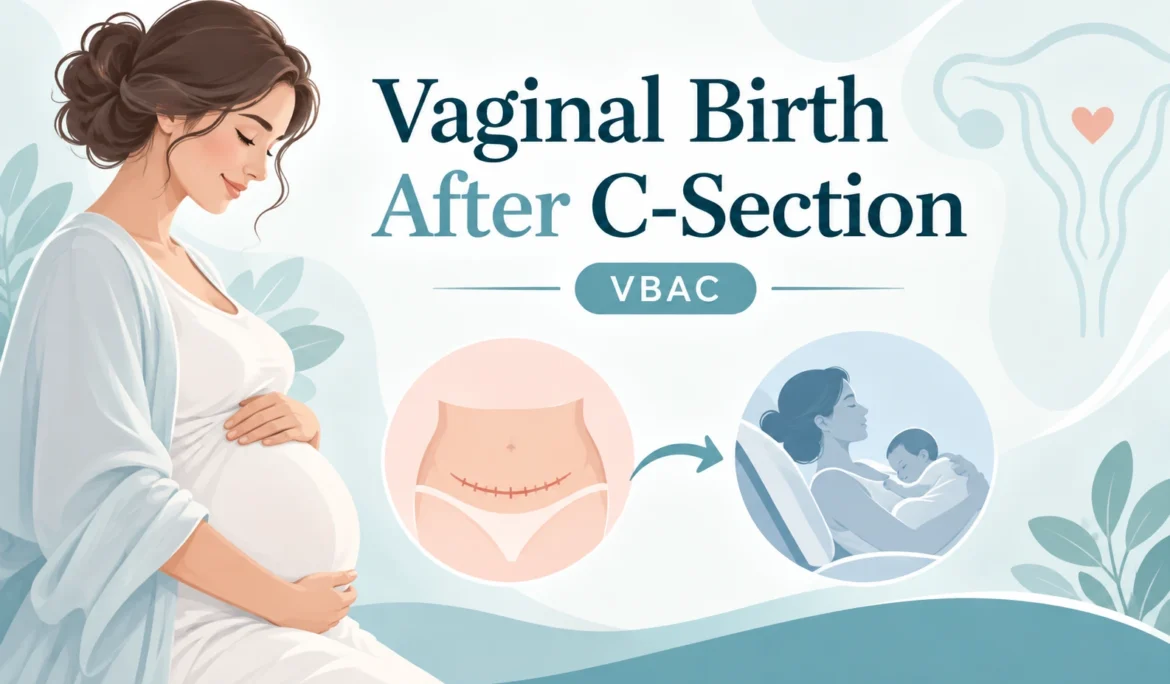
Many women who have had one previous caesarean can safely plan a vaginal birth after C-section. Guidance from the American College of Obstetricians and Gynecologists (ACOG) puts the success rate at roughly 60 to 80 per cent for women who attempt labour. The main risk is uterine rupture, estimated at 0.5 to 0.9 per cent after one previous low-transverse (horizontal) incision. Whether VBAC suits you depends on your scar type, why the first caesarean happened, and whether your hospital can run an emergency caesarean at short notice.
“Once a caesarean, always a caesarean” used to be the rule. It no longer is. If you are pregnant after a caesarean, vaginal childbirth after C-section surgery is a re al option that deserves a proper conversation with your obstetrics hospital in Delhi, ideally before the third trimester.
VBAC vs Repeat Caesarean at a Glance
| Planned VBAC | Planned repeat caesarean | |
| Chance of vaginal birth | About 60 to 80% of attempts succeed | None; it is a surgical birth |
| Hospital stay | Usually shorter | Usually longer |
| Recovery | Generally quicker, though a perineal tear or episiotomy is possible | Abdominal wound healing takes weeks |
| Main risk | Uterine rupture (rare); an attempt that ends in emergency caesarean | Infection, bleeding, injury to bladder or bowel, clots |
| Effect on future pregnancies | A successful VBAC lowers the chance of problems later | Each further caesarean raises the risk of placenta previa and placenta accreta |
| Planning | Needs a hospital with emergency surgery on standby | Date can be scheduled |
Are You a Good Candidate?
C-section surgery and vaginal birth can go together when the following apply:
- One previous caesarean with a low-transverse uterine incision (two previous may be considered case by case)
- A pregnancy with one baby, head down
- No other uterine surgery or condition that makes labour unsafe
- A hospital able to monitor you and perform an emergency caesarean
- Your obstetrician agrees after reviewing your operation notes
VBAC is generally not offered if you had a classical (vertical, upper uterus) incision, have had a uterine rupture before, or have a medical reason that rules out labour, such as placenta previa.
What Raises or Lowers Your Chances
| Tends to help | Tends to lower the odds |
| A previous vaginal birth, before or after the caesarean | First caesarean was for labour that stopped progressing |
| Labour that starts on its own | Induction of labour |
| First caesarean was for breech or fetal distress, which do not necessarily repeat | Under 19 months since the last caesarean |
| Younger maternal age | Higher BMI, older age, a very large baby |
Induction is not forbidden, but it carries a higher rupture risk than spontaneous labour, so doctors weigh it carefully.
The Risks, Without the Scare
- Uterine rupture: the old scar opens during labour. It is uncommon, which is exactly why a hospital with an operating theatre ready matters. A warning sign is a sudden change in the baby’s heart rate.
- Failed trial of labour: about one in four attempts ends in a caesarean anyway. An emergency caesarean after labour carries more risk than a planned one.
- Higher chance of infection and transfusion in those emergency cases.
Weighed against this are the risks of repeat surgery, which grow with every caesarean.
What Happens During a VBAC Labour
1. You arrive in active labour, or are admitted if labour begins.
2. A drip line is placed, blood is grouped and saved in case it is needed.
3. Your baby’s heartbeat is monitored continuously.
4. Pain relief, including an epidural, is allowed; it does not mask a rupture.
5. Labour progress is checked; if it stalls or the baby shows distress, the team moves to caesarean.
Recovery After a Vaginal Birth Following Caesarean
- Most women are up and walking within hours and go home sooner than after surgery
- You can lift your baby and drive again earlier than after an abdominal operation
- Perineal soreness is common for a week or two; warm compresses and prescribed pain relief help
- Watch for heavy bleeding, fever or worsening pain and call your doctor if they appear
- If the trial ends in caesarean, recovery follows the usual surgical timeline
Questions to Settle With Your Doctor Before Labour
- What type of incision did my first caesarean leave?
- What is my personal chance of success?
- Is an anaesthetist and surgical team available round the clock?
- What happens if my labour does not start by my due date?
- Under what circumstances would you advise a repeat caesarean?
Several of these are answered by a doctor reading your previous operation notes, so bring them to your first visit.
Gynaecologist Hospital in Delhi for Vaginal Birth After C-Section
If you are searching for an obs and gynae in Delhi, or any gynaecologist in Delhi for vaginal birth after C-section, begin with the questions above rather than with a ranking. A good obstetrics and gynaecology hospital in Delhi will discuss VBAC openly, review your scar history and tell you plainly if a repeat caesarean is safer for you.
Primus Hospital lists obstetrics, prenatal and postnatal care, C-section and gynaecology services. If you want to plan a vaginal birth after caesarean there, call before booking to confirm that VBAC is offered and what emergency cover is available. Seeing your obstetrician early in pregnancy gives enough time to decide calmly, and the plan can still change as the pregnancy goes on.