A brain tumor diagnosis brings a flood of questions, and understandably so. Is it cancerous? What type is it? What does treatment actually involve? The good news is that brain tumors vary enormously in behaviour and outlook, and many are far more manageable than the word “tumor” might initially suggest. This guide breaks down the main brain tumor types and what brain tumor treatment in Delhi typically looks like today.
What Is a Brain Tumor?
A brain tumor is an abnormal growth of cells within the brain. Tumors are broadly classified as:
- Benign (non-cancerous): These grow slowly, don’t spread to other tissues, and often have a good long-term outlook, though they can still cause serious symptoms depending on their size and location.
- Malignant (cancerous): These grow more aggressively, can invade surrounding brain tissue, and require more intensive treatment.
Brain tumors are also classified as primary, meaning they originated in the brain itself, or metastatic (secondary), meaning they spread to the brain from cancer elsewhere in the body, most commonly the lung, breast, or skin (melanoma).
Common Brain Tumor Types
There are more than 150 documented types of brain tumors, but a handful account for the vast majority of cases.
Meningioma
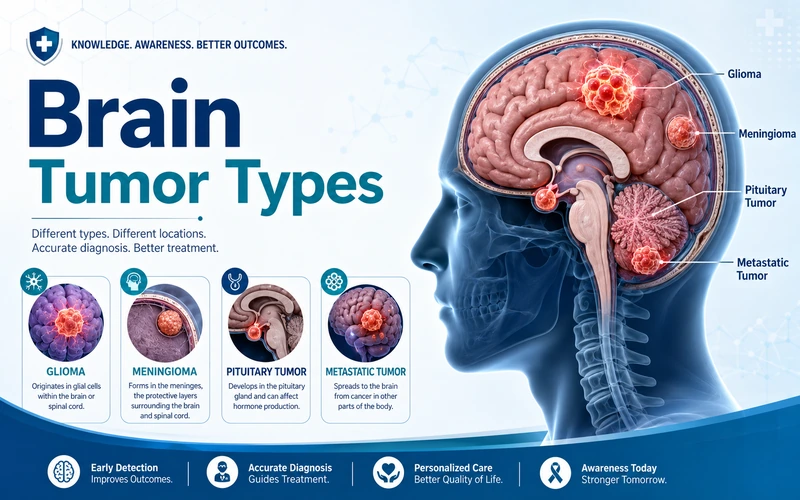
Meningiomas develop in the meninges, the protective membrane layers covering the brain and spinal cord. According to the Central Brain Tumor Registry of the United States (CBTRUS), meningioma is the single most common primary brain tumor type, accounting for roughly 42% of all primary brain and CNS tumors diagnosed. Most meningiomas are benign (Grade 1) and slow-growing, which is exactly why many are found incidentally on imaging and simply monitored rather than treated immediately. A smaller portion are atypical (Grade 2) or malignant (Grade 3), which grow faster and require more aggressive treatment.
Glioma
Gliomas arise from the brain’s glial cells, the supportive tissue surrounding neurons. This category includes several subtypes:
- Astrocytoma: Ranging from slow-growing, low-grade forms to aggressive, high-grade tumors
- Oligodendroglioma: Generally slower-growing than most astrocytomas
- Glioblastoma (GBM): The most aggressive and most common malignant primary brain tumor, requiring intensive, multi-modal treatment
Gliomas are graded from I to IV based on how abnormal the cells look and how quickly they’re likely to grow, which directly shapes the treatment approach.
Pituitary Tumors
These develop in the pituitary gland at the base of the brain and are usually benign. Because the pituitary gland regulates hormone production, these tumors can cause hormonal symptoms in addition to, or instead of, typical neurological symptoms.
Metastatic (Secondary) Brain Tumors
These are tumors that have spread to the brain from cancer elsewhere in the body. Treatment typically requires coordinated care between neurosurgery and oncology, since managing the primary cancer is just as important as treating the brain lesion itself.
Nerve Sheath Tumors (Acoustic Neuroma / Schwannoma)
These develop from the cells surrounding nerves, most commonly the nerve responsible for hearing and balance. They’re usually benign and slow-growing.
Symptoms of a Brain Tumor
Symptoms depend heavily on the tumor’s size and location, but commonly include:
- Persistent or worsening headaches, particularly in the morning
- Seizures, especially in someone with no prior seizure history
- Nausea or vomiting without an obvious cause
- Vision or hearing changes
- Balance or coordination difficulties
- Weakness or numbness on one side of the body
- Changes in memory, personality, or speech
- Difficulty with concentration or confusion
How Brain Tumors Are Diagnosed
Diagnosis typically involves:
- Neurological examination: Testing vision, hearing, balance, coordination, and reflexes
- MRI scan: The primary imaging tool for identifying a tumor’s location, size, and characteristics
- CT scan: Sometimes used alongside MRI, particularly in emergency settings
- Biopsy: A tissue sample is often necessary to confirm the exact tumor type and grade, which directly guides treatment decisions
Brain Tumor Treatment in Delhi
Tumor treatment in Delhi is tailored to the tumor’s type, grade, size, and location, along with the patient’s overall health. The main approaches include:
Surgery
Surgical removal (craniotomy) remains the primary treatment for most accessible brain tumors. Surgeons aim to remove as much of the tumor as safely possible without damaging critical brain function. Modern techniques like awake craniotomy (where the patient remains conscious during parts of the surgery to help the surgeon avoid areas controlling speech or movement) and computer-assisted, image-guided surgery have significantly improved precision and safety.
Radiation Therapy
Used either after surgery to target remaining tumor cells, or as a primary treatment when surgery isn’t feasible. Stereotactic radiosurgery delivers highly focused radiation to the tumor while sparing surrounding healthy brain tissue.
Chemotherapy
More commonly used for malignant gliomas and metastatic tumors, either alongside radiation or following surgery, to target remaining cancer cells throughout the treatment course.
Targeted and Supportive Therapies
Depending on the tumor type, additional treatments like anti-seizure medication, corticosteroids to reduce swelling, and rehabilitation therapy (physiotherapy, speech therapy, occupational therapy) often play an important role in overall recovery and quality of life.
Active Monitoring
For small, asymptomatic, benign tumors like many low-grade meningiomas, doctors may recommend regular MRI monitoring instead of immediate treatment, stepping in only if the tumor grows or begins causing symptoms.
Brain Tumor Surgery Cost in Delhi
Brain tumor surgery cost in Delhi typically ranges from approximately ₹2,00,000 to ₹10,00,000, depending on several factors:
- Type of surgery (standard craniotomy vs. minimally invasive neuroendoscopy)
- Tumor size, location, and complexity
- Length of ICU and hospital stay
- Use of advanced technology like intraoperative imaging or neuronavigation
- Pre- and post-surgical diagnostics and rehabilitation needs
Since brain tumor cases vary widely, it’s important to get a personalised estimate from your hospital after a full diagnostic workup, rather than relying on general figures alone.
When to Consult a Neurosurgery Specialist in Delhi
Book a consultation promptly if you or a loved one experiences:
- Persistent headaches that are worsening or different from your usual pattern
- A new seizure with no prior history
- Sudden vision, hearing, balance, or coordination changes
- Unexplained weakness or numbness on one side of the body
- Noticeable changes in memory, personality, or speech
Understanding the specific type of brain tumor involved is the first step toward making sense of a diagnosis and the treatment path ahead. With advances in imaging, minimally invasive surgery, and combination therapies, outcomes for many brain tumor types have improved significantly. If you or a loved one is facing a brain tumor diagnosis in Delhi, Primus Super Speciality Hospital’s neuroscience team offers experienced, coordinated care to guide you through diagnosis, treatment, and recovery.
Primus Super Speciality Hospital offer a dedicated Department of Neuroscience equipped for advanced neurosurgical care designed to minimise scarring and support faster recovery. Primus provides coordinated, personalised care for patients navigating a brain tumor diagnosis in Delhi, from initial diagnosis through surgery and rehabilitation.