
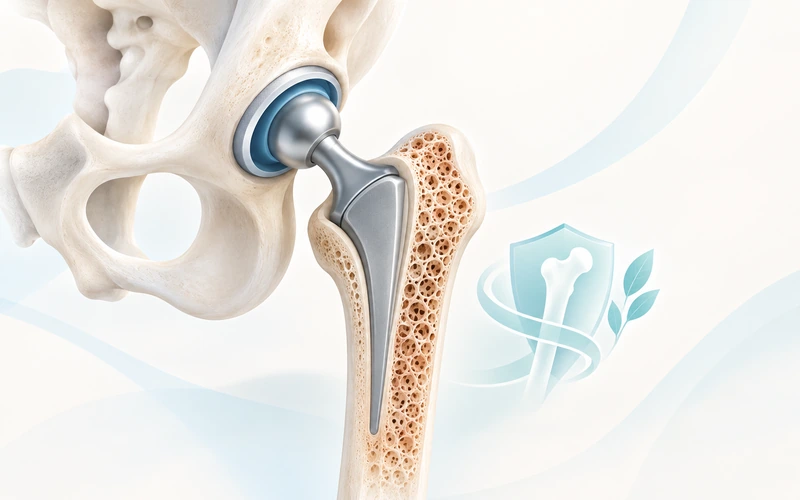
Patients occasionally ask their surgeon a version of the same question after being diagnosed with both weak bones and joint damage: if I’m getting a new joint anyway, does that fix my osteoporosis too? It’s a fair question, and the honest answer requires separating two things that often get bundled together in casual conversation: a joint problem and a bone density problem.
Quick answer: Arthroplasty (joint replacement) does not treat osteoporosis. Osteoporosis is a systemic bone-thinning condition managed with medication and lifestyle changes, while arthroplasty addresses damage to a single joint. The two conditions are closely linked in practice; osteoporosis affects surgical planning and outcomes, but joint replacement in Delhi itself doesn’t reverse or treat the underlying bone disease.
Two Different Problems That Often Show Up Together
Osteoporosis is a gradual loss of bone density and strength throughout the skeleton, increasing fracture risk, particularly at the hip, spine, and wrist. Arthroplasty replaces a specific joint surface, most often the knee or hip, when arthritis or damage has progressed beyond what medication or physiotherapy can manage. Because both conditions become more common with age, and often in the same patients, it’s easy to assume treating one addresses the other. In practice, orthopaedic surgeons treat them as related but distinct concerns requiring separate management.
Does Joint Replacement Actually Improve Bone Density?
Not directly, and in one specific way, it can do the opposite. After a hip or knee replacement, the bone immediately surrounding the implant can lose density over time through a process called stress shielding, where the implant bears more of the mechanical load, leaving the adjacent natural bone doing comparatively less work and gradually weakening. This is well documented in orthopaedic research and is precisely why bone health monitoring doesn’t end once a replacement surgery is successfully completed.
When Osteoporosis Actually Leads to an Arthroplasty
The clearest genuine connection runs the other way: a fragility fracture caused by osteoporosis, a hip fracture from a minor fall being the most common example, is frequently treated surgically with arthroplasty, either a partial or total hip replacement, depending on the specific fracture and the patient’s overall condition. This is the surgery treating the fracture osteoporosis caused, not the disease itself, an important nuance worth understanding rather than assuming the surgery is somehow correcting the bone condition.
Why Osteoporosis Changes the Calculation Before Surgery
Patients with unrecognised or untreated osteoporosis face meaningfully higher surgical risk. Studies estimate that osteoporosis or low bone density is present in roughly two-thirds of patients undergoing joint replacement, yet a large majority go untreated for it at the time of surgery. Weak bone complicates implant fixation and raises the risk of a periprosthetic fracture, a break occurring around the implant itself, a complication associated with significantly higher rates of hospital readmission and reduced one-year survival compared to routine recoveries.
The Pre-Surgery Bone Health Checklist
A DEXA bone density scan before elective joint replacement, particularly for older patients or those with known risk factors. Correction of vitamin D and calcium deficiencies well ahead of the surgical date, not as a last-minute addition. A surgeon’s assessment of whether cemented or cementless implant fixation better suits your specific bone quality. Starting or continuing appropriate osteoporosis medication, coordinated between your orthopaedic surgeon and physician rather than paused without discussion.
Why Bone Protection Continues After the Surgery Too
Research on bisphosphonates, a standard class of osteoporosis medication, shows they can meaningfully reduce both bone density loss around a new implant and overall revision surgery rates in patients with osteoporosis. This is a genuinely useful, evidence-based reason for osteoporotic patients to stay engaged with bone health management well beyond the recovery period, rather than considering the joint problem “solved” and the bone question closed.
Arthroplasty and Joint Replacement Options in Delhi
Knee arthroplasty ranges from partial to total knee replacement depending on how much of the joint is affected, while hip arthroplasty spans resurfacing to full total hip replacement, with the choice shaped by the pattern of damage, age, and bone quality together. Modern fixation options, including cemented, cementless, and hybrid approaches, give surgeons flexibility to match the implant strategy to each patient’s actual bone density rather than a one-size-fits-all approach.
Cost of Arthroplasty Surgery
In Delhi, total knee replacement typically costs between roughly ₹1.5 lakh and ₹4.5 lakh per knee, and total hip replacement generally falls between about ₹2.5 lakh and ₹7 lakh per hip, depending on implant choice, fixation method, hospital category, and room type. Patients with significant osteoporosis may need additional pre-operative evaluation or a specific implant approach, which is why a personalised consultation gives a far more accurate estimate than a generic online figure.
When to Consult an Orthopaedic Specialist in Delhi
Book a consultation with an orthopaedic specialist in Delhi if you have joint pain that hasn’t improved with conservative treatment, an existing osteoporosis diagnosis alongside joint symptoms, or you’ve experienced a fragility fracture and are unsure what comes next. Addressing your joint and your bone density together, rather than separately, leads to better-informed surgical planning.
Arthroplasty and osteoporosis are connected, but not in the way the question often implies: joint replacement doesn’t treat osteoporosis, and osteoporosis isn’t fixed by getting a new joint. What matters is recognising how the two genuinely interact: osteoporosis shapes surgical risk and planning, fractures it causes sometimes require arthroplasty to repair, and bone protection remains relevant long after the surgery itself. Primus Hospital’s orthopaedic team in Delhi offers the kind of combined assessment that takes both conditions seriously rather than treating either in isolation.
Primus Hospital’s Department of Orthopedics in Chanakyapuri offers comprehensive joint replacement care alongside the diagnostic capability to properly assess bone quality before and after surgery. As a trusted centre for joint replacement in Delhi, Primus Hospital’s approach treats bone health as an ongoing part of arthroplasty care, not a box checked once before the operating theatre. Learn more or book a consultation at primushospital.com.