Both cause severe pain. Both are commonly called “stones.” Beyond that, kidney stones and gallbladder stones are genuinely different conditions, different organs, different causes, and different treatment paths entirely. Confusing the two is common, and it shouldn’t be, since the right treatment depends entirely on knowing which one you actually have.
According to the gastroenterologist in Delhi, Kidney stones form from crystallised minerals in urine and cause flank pain, blood in urine, and painful urination. Gallstones form from hardened bile in the gallbladder and cause upper right abdominal pain after fatty meals, often with nausea. Small kidney stones frequently pass on their own; gallstones causing symptoms are usually treated by removing the gallbladder entirely.
What Makes kidney stone and gallstone different?
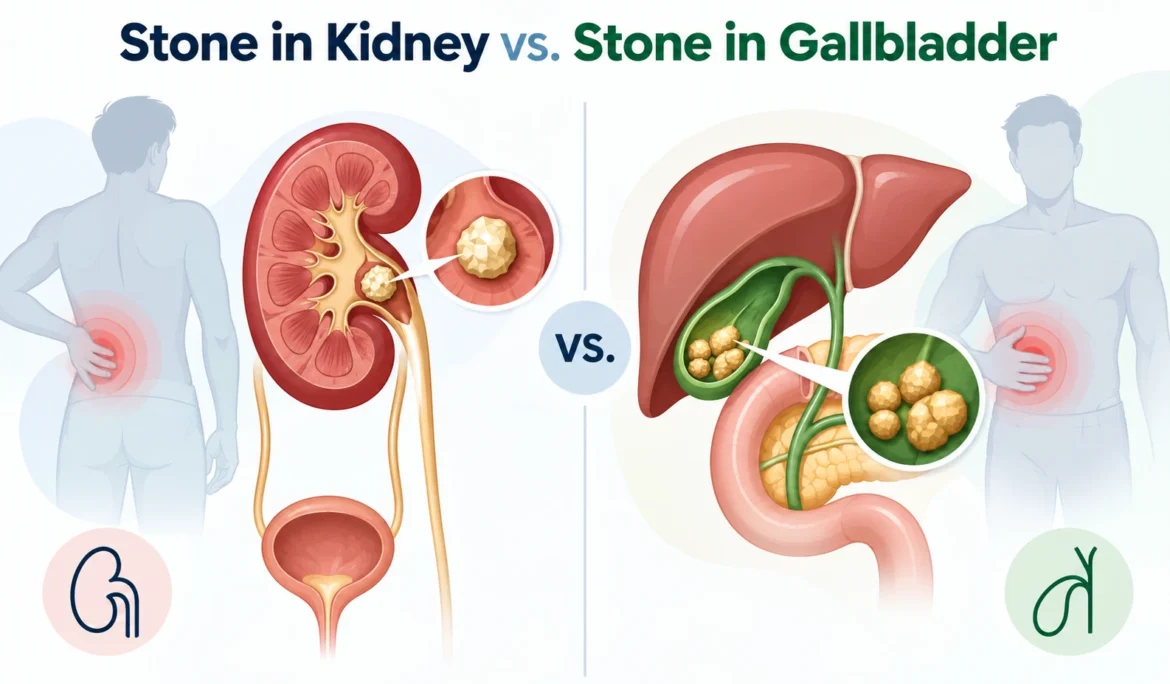
Kidney stones and gallstones form in completely different organs, through completely different processes, and that difference drives everything about their treatment.
| Feature | Kidney Stones | Gallbladder Stones |
| Organ affected | Kidneys and urinary tract | Gallbladder and bile ducts |
| Made of | Crystallised minerals (calcium, oxalate, uric acid) | Hardened cholesterol or bilirubin |
| Typical pain location | Back or side, radiating to groin | Upper right abdomen, radiating to shoulder |
| Common trigger | Dehydration, high-oxalate diet | Fatty or heavy meals |
| Associated symptoms | Blood in urine, burning urination | Nausea, bloating after eating |
| Can it pass on its own? | Often, if under 10mm | Rarely, reliably |
Symptoms: How to Tell Them Apart
Both cause severe pain, but the pattern and location differ meaningfully.
Kidney stone pain typically starts in the back or side and radiates toward the lower abdomen and groin, often described as one of the most severe pains a person can experience, and frequently comes with blood in the urine or a burning sensation when urinating.
Gallstone pain concentrates in the upper right abdomen, often triggered specifically by fatty or heavy meals, and frequently accompanied by nausea, bloating, and sometimes pain radiating to the right shoulder blade.
Causes and Risk Factors
Kidney Stones
Dehydration, high-sodium or high-oxalate diets, obesity, certain metabolic conditions, and family history all raise kidney stone risk. Insufficient water intake is one of the most common and most preventable contributing factors.
Gallstones
Excess cholesterol in bile, rapid weight loss, obesity, and being over 40 all raise gallstone risk, cholesterol stones are the most common type by far. Family history and female sex also increase risk.
Stone Removal Without Surgery: What’s Actually Possible
For Kidney Stones
Stones under 10mm often pass naturally with hydration and pain management. Shock wave lithotripsy (SWL) uses focused sound waves from outside the body to break larger stones into fragments small enough to pass in urine, a genuinely non-surgical option for appropriately sized stones.
For Gallstones
Options here are far more limited. Medication to dissolve small cholesterol stones exists but works slowly and has limited real-world effectiveness, which is why it’s rarely used today. Unlike kidney stones, gallstones don’t reliably pass on their own, and non-surgical approaches generally aren’t the first recommendation for symptomatic gallstones.
Kidney Stone Surgery Options in Delhi
- Ureteroscopy inserts a thin scope through the urinary tract to locate and break up or remove the stone directly, suited to small to medium stones, particularly in the ureter
- Shock wave lithotripsy remains an option for many mid-sized stones as described above, sometimes combined with a stent to help fragments pass comfortably
- Percutaneous nephrolithotomy (PCNL) is reserved for large or complex kidney stones, accessing the kidney directly through a small incision in the back for stones too large for other methods
Gallbladder Stone Surgery: Laparoscopic Cholecystectomy
For symptomatic gallstones, laparoscopic cholecystectomy, surgical removal of the gallbladder through small incisions, remains the standard, most effective treatment. The gallbladder isn’t essential for digestion long-term, and removal resolves symptoms completely in the large majority of patients, with most people returning to a normal diet within a few weeks, sometimes adjusting fat intake afterward.
Minimally Invasive Surgery: What This Means for You
Both ureteroscopy and PCNL for kidney stones, and laparoscopic cholecystectomy for gallstones, are minimally invasive by design, smaller incisions, less post-operative pain, and meaningfully faster recovery than older open surgical approaches. A minimally invasive surgery hospital in Delhi with the right equipment and experienced surgeons across both urology and gastroenterology makes this the default approach for the majority of stone cases today; open surgery is now reserved for select complex situations.
When to Seek Emergency Care
Severe, unrelenting pain not responding to medication, fever with chills, persistent vomiting, or yellowing of the skin or eyes all warrant urgent evaluation regardless of which type of stone is suspected; these can signal infection or blockage that needs prompt treatment at a gastroenterology hospital in Delhi rather than a routine appointment.
Kidney stones and gallstones share a name but little else, different organs, different causes, and different treatment paths. Getting an accurate diagnosis first is what determines whether hydration and monitoring, a non-surgical procedure, or surgery is the right next step. Primus Hospital’s gastroenterology and urology teams in Delhi offer the diagnostic clarity needed to treat the stone you actually have, not just the symptom.
Primus Hospital brings together dedicated Gastroenterology and Urology departments under one roof. As a NABH-accredited gastroenterology hospital in Delhi performing over 3,000 surgeries annually, Primus offers coordinated evaluation and treatment for whichever type of stone you’re actually dealing with.
Learn more or book a consultation at primushospital.com.