







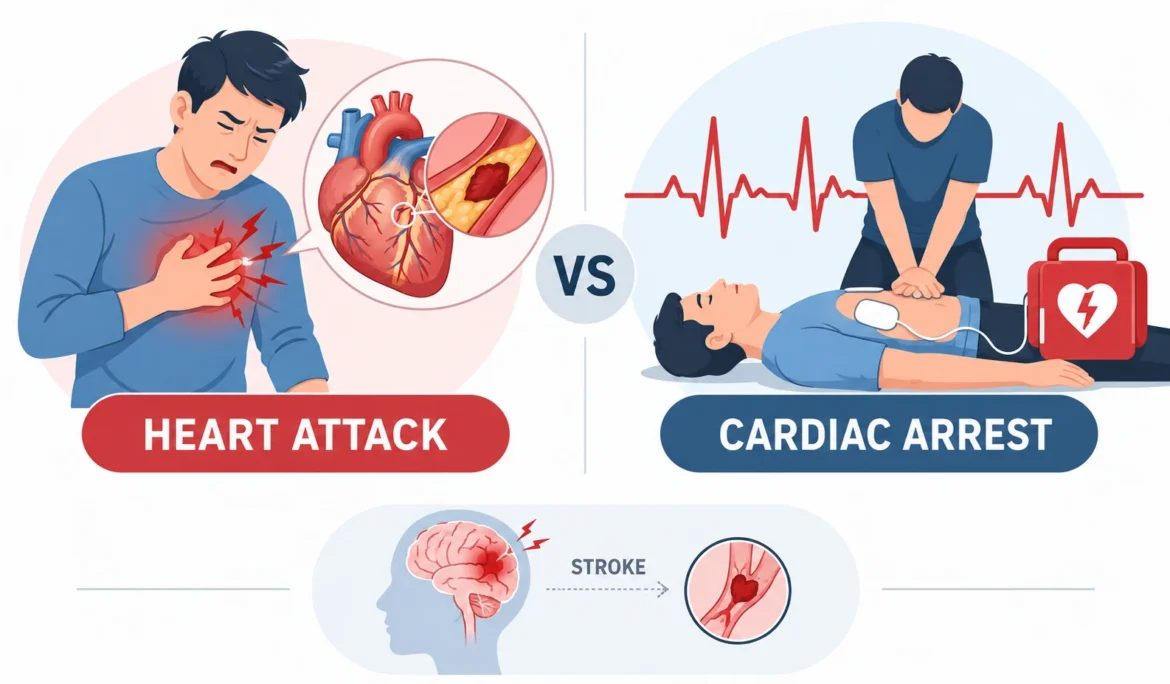
People use “heart attack” and “cardiac arrest” as if they meant the same thing. They do not, and mixing them up can cost minutes that a person does not have. A heart attack is a blocked blood supply to the heart. Cardiac arrest is a sudden electrical failure that stops the heart from pumping at all. A heart attack usually brings chest pain or pressure and other warning signs, and the person is awake. Cardiac arrest brings sudden collapse, no response and no normal breathing.
The American Heart Association describes a heart attack as a circulation problem and cardiac arrest as an electrical one. A heart attack can lead to cardiac arrest, but the two are not the same. Cardiac arrest needs CPR and a shock from a defibrillator within minutes. This guide explains the symptoms of each, with a closer look at cardiac arrest, how long a person can survive without help and what treatment is possible according to cardiologists in Delhi.
Heart Attack vs Cardiac Arrest: The Difference
According to the American Heart Association, a heart attack is caused by a blockage that stops blood flow to the heart, while cardiac arrest happens when the heart’s electrical system malfunctions.
| Feature | Heart attack | Cardiac arrest |
| What goes wrong | A blocked artery cuts blood flow to the heart muscle | The heart’s electrical signals fail and it stops pumping |
| Type of problem | Circulation | Electrical |
| Is the person awake? | Usually yes | No, they collapse and do not respond |
| Breathing | Usually present, may be laboured | Absent or gasping |
| Onset | Can build over days or hours, or arrive suddenly | Sudden |
| First response | Call for emergency help, keep the person calm | Call for help, start CPR, use an AED |
Symptoms of Heart Attack
The symptoms of a heart attack can vary from person to person. Common signs include:
- Chest pain or discomfort
- Pain spreading to the arms, back, neck, jaw or stomach
- Shortness of breath
- Nausea and lightheadedness
- Cold sweats
- Irregular or rapid heartbeat
Symptoms can build over days to weeks in some people, and some heart attacks are silent, with very mild signs or none. Medical News Today notes one estimate that silent heart attacks account for almost half of all heart attacks, so mild symptoms should not be brushed aside.
Symptoms of Cardiac Arrest and Cardiac Arrest Signs
The first and clearest sign of cardiac arrest is that the person suddenly loses consciousness. Look for these cardiac arrest signs:
- Sudden collapse
- No response when you shout or shake their shoulders
- No normal breathing, or only gasping
- No pulse
Some people notice warning symptoms in the hour before, such as a fast heartbeat, dizziness, chest pain, shortness of breath, nausea or vomiting. Many people have no warning at all, which is why cardiac arrest is described as sudden.
Pain of Cardiac Arrest: What Does It Feel Like?
The person who has a cardiac arrest loses consciousness within moments, so there is usually no pain once the arrest happens. Any chest pain tends to come beforehand, during the warning phase, and it may be a sign of a heart attack or another heart problem. If chest pain appears together with fainting or collapse, treat it as an emergency and take the patient to the nearest cardiology hospital.
Chances of Heart Attack and Stroke: What “Heart Stroke” Means
There is no medical condition called “heart stroke”. People who search for it usually mean one of two things. A heart attack affects the heart, while a stroke affects the brain, and the two have different symptoms and treatment. Heart disease is a major burden in India. Reports on a Lancet study say cardiac ailments killed 28% of Indians in 2016, more than any other non-communicable disease, and that hospital data from 2020 to 2023 show 50% of heart attack patients were under 40. Age is no longer a reason to wait and see.
Cardiac Arrest Survival Time: How Many Minutes Matter?
There is no fixed number of minutes for every person, but time is the deciding factor. A person can lose consciousness and die within minutes without immediate treatment, and the chance of survival drops quickly the longer defibrillation and CPR are delayed. In its coverage of the Union Health Ministry’s CPR Awareness Week, ETV Bharat reported the following points.
| Fact | Figure |
| Bystander CPR rate in India, per ministry data | 1.3% to 9.8% |
| Cardiac arrests that occur outside hospitals in India | Nearly 70% |
| Effect of immediate bystander CPR on survival | Two to three times higher |
| Drop in survival for each minute of delay, as cited in the report | About 10% |
In the United States, the American Heart Association cites more than 350,000 out-of-hospital cardiac arrest deaths each year. The same message applies in India: most arrests happen away from a hospital, so the first few minutes depend on the people nearby.
How to Be Ready for an Emergency
The Union Health Secretary has said the aim is to have at least one person trained in CPR in every household, school, office and public space, and she described hands-only CPR as a way to keep blood and oxygen moving until professional help arrives. You can act on that in a few simple ways.
- Learn hands-only CPR at a certified training session.
- Teach family members, neighbours and colleagues what a collapse looks like.
- Save emergency numbers where everyone at home can find them.
- Notice where AEDs are kept in your workplace, housing society or mall.
- Do not wait to see if symptoms pass. Treat sudden collapse as an emergency every time.
Consult at Cardiology Hospital in Delhi
Do not wait if you notice chest pain, breathlessness, unexplained sweating or a racing heartbeat, especially if you have high blood pressure, diabetes, high cholesterol, a history of smoking or a family history of heart disease. At Primus Hospital, the department of cardiology and cardiac sciences offers diagnosis and treatment for heart conditions, including angioplasty and cardiac surgery such as bypass, backed by 24×7 emergency care and intensive care support.
A heart attack and a cardiac arrest are two different emergencies. One is a blockage, the other an electrical failure, and both need action in minutes. Learn the signs, learn hands-only CPR and know where your nearest AED is.
Book an appointment with a heart specialist at Primus Hospital, or Contact Us to plan your visit.