Every 1 in 3 women and 1 in 5 men experience osteoporotic (fragility) fractures. Published estimates report ~50 million people in India with low bone mass/osteoporosis‑range T‑scores.
Osteoporosis is a bone‑weakening disease in which bone breakdown outpaces bone rebuilding. Hence, the skeleton loses strength and fractures happen with even low‑impact falls and routine movements. Osteoporosis is silent until the first fracture, and that fracture often becomes the turning point, because one fragility fracture sharply raises the risk of the next one. The article sharing insights by a specialist from top orthopaedic hospital in Delhi and explaining whether osteoporosis can be cured or not
Osteoporosis meaning in Hindi: ऑस्टियोपोरोसिस = हड्डियों का कमजोर और भुरभुरा हो जाना (हड्डियों की घनता कम होना
So, can osteoporosis be cured? Lets find out!
Osteoporosis Symptoms in Detail
Osteoporosis does not show initial signs of pain. This is the most dangerous part of the disease because people feel healthy while bone strength keeps reducing every year. Bones lose density from inside, therefore the outer shape of the body looks normal until a fracture happens.
Early Osteoporosis Symptoms
In the early stage, osteoporosis shows no obvious symptoms. This happens because bone loss is a slow biological process. The body does not send pain signals when bone density reduces.
Early symptoms include:
- Getting tired easily during standing or walking
- Mild back discomfort after long sitting
- Weak grip strength
- Reduced balance while walking
These signs appear because muscles and bones lose coordination as bone strength reduces.
More than 70 percent of osteoporosis patients report no symptoms before their first fracture. Therefore early diagnosis depends on testing and become essential.
Advanced Osteoporosis Symptoms
Advanced osteoporosis shows clear physical symptoms because bones become fragile and start collapsing under normal body weight.
Common advanced symptoms include:
- Sudden back pain due to spinal compression fractures
- Loss of height by 2 to 5 centimeters
- Bent or stooped posture
- Hip fracture after a simple fall
- Wrist fracture while trying to support the body
These fractures occur because the internal bone structure becomes porous and cannot absorb force.
A person who suffers one osteoporotic fracture has a 2 to 4 times higher risk of another fracture within the next 2 years. Hence fracture prevention becomes the main goal of treatment.
Why Osteoporosis Symptoms Appear Late
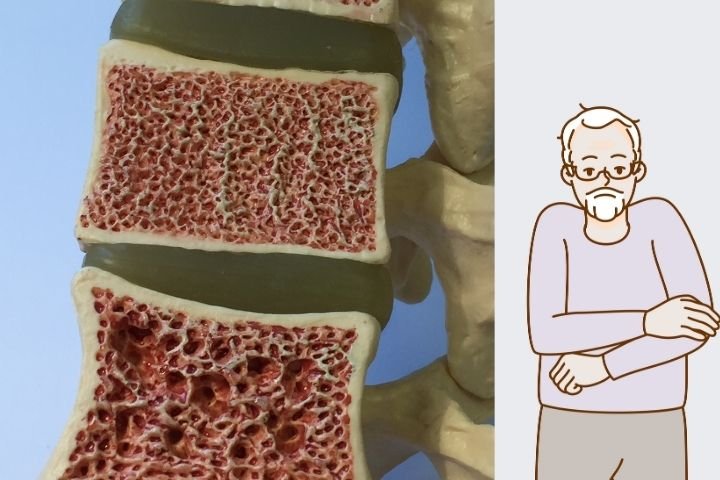
Osteoporosis affects the trabecular bone, which is the inner honeycomb like structure. This bone weakens silently because it does not carry nerves like muscles or skin. Therefore pain does not occur until the bone collapses.
Osteoporosis Causes
Osteoporosis develops when bone loss happens faster than bone formation. This imbalance continues for years, therefore bone density keeps reducing.
Main Osteoporosis Causes
- Calcium deficiency
Calcium forms the basic structure of bones. When intake stays low for years, bones lose stored calcium, hence density falls. - Vitamin D deficiency
Vitamin D helps absorb calcium. Without it, even a good diet fails to strengthen bones. - Hormonal changes
After menopause, estrogen levels fall sharply. Estrogen protects bone mass, therefore women lose bone faster after menopause. - Aging
After age 35, bone formation slows. Bone loss continues, hence net density reduces every year. - Lack of physical activity
Bones need weight bearing stress. Without movement, bones weaken because the body stops maintaining strength. - Long term steroid use
Steroids block bone formation and increase calcium loss, therefore fracture risk rises quickly.
Can Osteoporosis Be Cured
Osteoporosis is not an infection, therefore it does not disappear permanently. However, modern orthopedic treatment stops bone loss, increases bone density, and reduces fracture risk to a safe level.
What Treatment Achieves
- Bone density increases by 6 to 13 percent within 18 to 24 months with proper medicine
- Vertebral fracture risk reduces by 60 to 70 percent
- Hip fracture risk reduces by 35 to 45 percent
Therefore patients live normal active lives without repeated fractures.
Diagnosis of Osteoporosis in Delhi
Most patients do not feel pain until a fracture occurs. Therefore Delhi’s orthopedic specialists in Ghaziabad also rely on objective medical tests.
Clinical Evaluation and Medical History
Diagnosis begins with a detailed clinical evaluation by an orthopedic specialist in Delhi. The specialist reviews age, body weight, height loss over time, and posture changes. They also ask about fractures that occurred after minor falls, because such fractures strongly suggest bone weakness.
DEXA Scan as the Primary Diagnostic Test
A DEXA scan is the gold standard test for diagnosing osteoporosis. DEXA stands for Dual Energy X ray Absorptiometry. This scan measures bone mineral density precisely. The test focuses on the spine and hip because these bones fracture most often and predict future fracture risk reliably.
The result appears as a numerical value called the T score. The T score compares a patient’s bone density with that of a healthy young adult.
- A T score above minus one indicates normal bone strength
- A T score between minus one and minus two point five indicates low bone mass
- A T score below minus two point five confirms osteoporosis
Each one point drop in T score almost doubles fracture risk. Therefore even small changes carry clinical importance.
Role of X Rays in Diagnosis
X rays do not detect early osteoporosis because bone loss becomes visible only after significant damage. However X rays play a supporting role. They help identify silent spinal compression fractures that many patients do not feel. Detecting these fractures changes treatment intensity and urgency.
Blood Tests to Identify Underlying Causes
Blood tests form an essential part of diagnosis. They help identify secondary causes of bone loss. Common tests include vitamin D levels, calcium levels, thyroid function, and parathyroid hormone levels.
Fracture Risk Assessment and Final Diagnosis
Orthopedic specialists combine DEXA results with age, weight, previous fractures, and medical history to calculate future fracture risk. This risk assessment decides treatment strength and duration. High risk patients require stronger therapy early, while low risk patients follow gradual protocols.
Treatment for Osteoporosis in Delhi
The first objective is to slow bone resorption, because rapid bone loss weakens the skeleton continuously.
Osteoporosis Medicines Used in Treatment
Oral medicines remain the first line of treatment for most patients. These medicines act on bone destroying cells and suppress their activity. When bone breakdown slows, existing bone mass stays preserved. This creates a stable internal structure.
Along with these medicines, calcium supplementation stays compulsory. Calcium provides the mineral foundation for bones. Vitamin D is always added because calcium absorption depends on it. Without vitamin D correction, medicine response remains incomplete.
Common medicine components include:
- Oral anti bone loss tablets with long safety records
- Calcium supplements adjusted to daily requirements
- Vitamin D supplements to maintain absorption efficiency
Treatment duration stays fixed and predictable. Most patients continue oral treatment for three to five years. Bone density scans guide continuation or adjustment. Decisions depend on numbers, not symptoms.
Osteoporosis Injection Treatment in Delhi
Injection therapy is reserved for moderate to severe osteoporosis. Orthopedic specialists recommend injections when bone density values are very low or fractures already exist. Injections are also used when oral medicines fail to control bone loss. Injection therapy works through a different biological pathway. These treatments directly influence bone forming cells. As a result, bone formation increases faster compared to tablets. Structural improvement becomes measurable within months.
This treatment follows a time bound protocol. Therapy usually continues for twelve to twenty four months. After completion, patients shift to oral medicines for long term maintenance.
Injection therapy delivers defined outcomes:
- Strong improvement in spine bone density
- Major reduction in vertebral fracture occurrence
- Better reinforcement of hip and weight bearing bones
Injection therapy is chosen because clinical data proves its benefit in high risk patients.
Osteoporosis Therapy Beyond Medicines
Weight bearing exercises stimulate bone tissue. Muscle strengthening improves joint control. Balance training reduces fall mechanics. These interventions work because falls cause most osteoporotic fractures.
Osteoporosis Surgery in Delhi
Osteoporosis itself does not require surgery. Surgery becomes necessary only after structural bone failure.
Hip fractures represent the most serious complication. These fractures prevent standing and walking. Surgical fixation becomes mandatory to restore weight bearing ability. Delay increases disability risk.
Spinal compression fractures may also need surgery. Severe pain, progressive deformity, or nerve compression indicate surgical stabilization. Procedures aim to restore vertebral height and spinal alignment.
Surgery focuses on three goals:
- Structural stability
- Pain control
- Early mobilization
Post surgical rehabilitation begins early to prevent complications.
Can osteoporosis be cured, whats the truth?
No, osteoporosis cannot be completely cured but yes, it can be effectively controlled, slowed, and fractures can be prevented with the right treatment and lifestyle changes.For complete osteoporosis evaluation and long term bone care, Primus Hospital , a super specialty hospital in Delhi offers structured diagnosis, non surgical treatment, injection based therapy, and fracture management under one roof. Patients receive treatment based on bone density values, fracture risk, and clinical evidence, not assumptions.