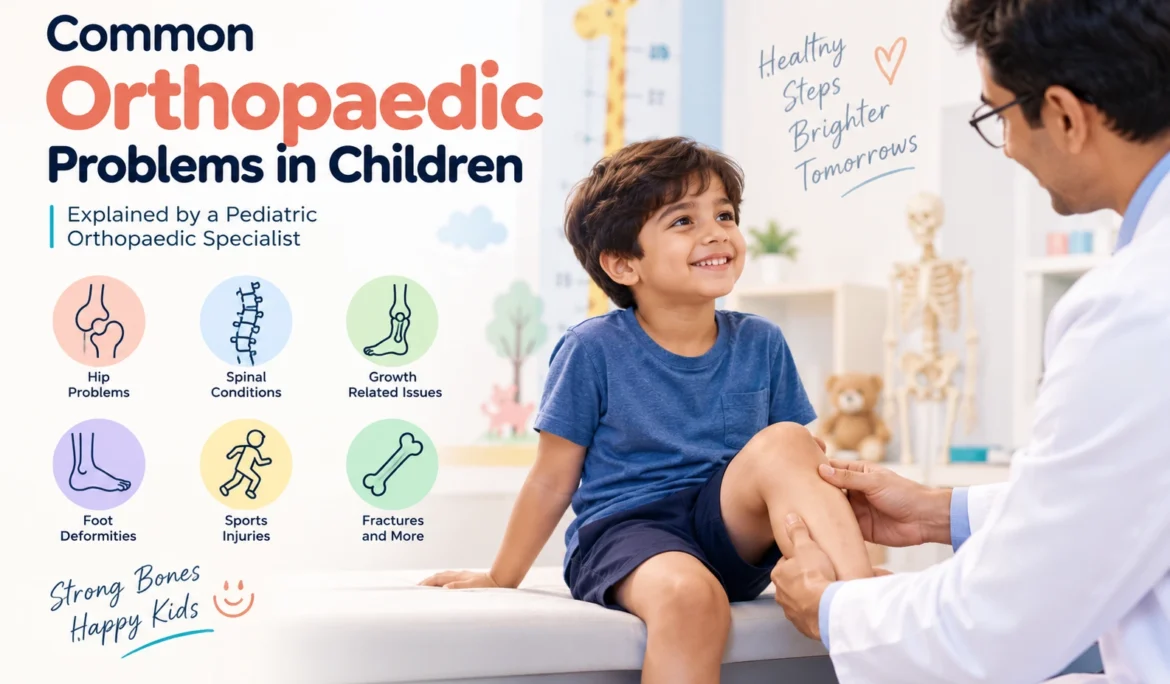
Watching your child limp, complain of leg pain, or walk with their feet turned inward can be genuinely worrying for any parent. The reassuring news is that most pediatrics orthopedics problems are common, well understood, and highly treatable, especially when identified early. This guide, explained by a pediatric orthopaedic specialist in Delhi, covers pediatric orthopaedic conditions organised by the part of the body they affect, so you know what’s typical, what needs attention, and when to see a specialist.
Why Children’s Orthopaedic Care Is Different From Adult Care
Children aren’t simply small adults, medically speaking. Their bones are still growing, with active growth plates that continue developing until late adolescence. This means the same injury or condition can behave very differently in a child compared to an adult, and it’s also why pediatric orthopaedics exists as a distinct medical field, with specialists trained specifically in how growing bones, joints, and muscles develop and heal.
Foot and Leg Conditions in Children
- Flat Feet: Flat feet, where the arch of the foot appears low or absent, are extremely common in toddlers and young children. In most cases, this is a normal part of development and improves naturally as the foot’s arch forms over the early school years. Flat feet generally only need evaluation if they’re causing pain, stiffness, or noticeable difficulty walking.
- In-Toeing and Out-Toeing: Many young children walk with their feet turned slightly inward (in-toeing) or outward (out-toeing). These patterns are usually related to how the legs are rotated in the womb or during early growth, and the large majority resolve on their own by the time a child reaches school age, without any treatment needed.
- Bow Legs and Knock Knees: It’s completely normal for toddlers to have bowed legs, and equally normal for slightly older children to develop knock knees as their legs straighten out during growth. Both patterns typically self-correct over time. Persistent, worsening, or one-sided bowing, however, warrants an evaluation to rule out an underlying growth or bone condition.
- Clubfoot: According to specialists at pediatrics orthopedics hospital in Delhi, clubfoot is a congenital condition present at birth, where one or both feet turn inward and downward. According to the American Academy of Orthopaedic Surgeons, clubfoot occurs in approximately 1 in every 1,000 live births, making it one of the more common congenital foot deformities seen by pediatric orthopedic specialists. It isn’t painful for the infant, but it does require prompt treatment, typically through the Ponseti method (a gentle, non-surgical series of castings), to ensure normal walking and foot function as the child grows.
Hip Conditions in Children
Developmental Dysplasia of the Hip (DDH): DDH occurs when a baby’s hip joint hasn’t formed correctly, ranging from mild looseness to a fully dislocated hip. It’s typically screened for during routine newborn and infant check-ups, since early detection allows for simple, non-surgical treatment, usually a harness that gently holds the hip in the correct position. Left undiagnosed, DDH can lead to a noticeable limp, uneven leg length, or early arthritis later in life.
Perthes Disease: This condition involves a temporary disruption of blood supply to the top of the thigh bone, most often affecting children between four and eight years old. It typically causes a limp and hip or knee pain, and while it sounds alarming, most cases respond well to monitoring, activity modification, and physical therapy, with surgery reserved for more severe presentations.
Spine Conditions in Children
Scoliosis is a sideways curve of the spine, most commonly appearing during the growth spurt of early adolescence. It’s rarely painful in its early stages, which is exactly why routine school or pediatric screenings matter, mild curves often go unnoticed by children and parents until they’re specifically checked for. Treatment depends heavily on the degree of curvature: small curves are simply monitored over time, moderate curves may need bracing, and larger curves occasionally require surgical correction.
Growth-Related and Overuse Conditions
Growing Pains: Despite the name, growing pains aren’t fully understood medically, but they’re a recognised, benign pattern of aching, typically in the legs, that occurs in the evening or at night in otherwise healthy, active children. They don’t cause limping, swelling, or daytime symptoms, and they resolve without specific treatment, though persistent or one-sided pain always deserves a proper evaluation rather than being automatically dismissed as growing pains.
Sports and Overuse Injuries: As children become more active in organised sports, overuse injuries like Osgood-Schlatter disease (pain and swelling just below the kneecap) and Sever’s disease (heel pain related to growth) have become increasingly common, particularly during growth spurts. These conditions generally respond well to activity modification, stretching, and, when needed, guided physical therapy.
Fractures in Children
Because children are active and their bones are still developing, fractures are one of the most frequent reasons for a visit to a pediatric orthopedic specialist. Importantly, children’s bones heal differently than adult bones, they’re more flexible and generally heal faster, but growth plate injuries specifically need careful evaluation, since improper healing near a growth plate can occasionally affect a bone’s future growth.
When Should You See a Pediatric Orthopedic Specialist in Delhi?
Consult a pediatric orthopedic specialist in Delhi if your child experiences persistent limping, pain that doesn’t improve with rest, one-sided or worsening leg or foot deformity, visible swelling around a joint, difficulty bearing weight after a fall, or a noticeable curve in their spine or posture. Early evaluation allows for simpler, more effective treatment, and rules out the less common conditions that do need timely medical attention.
Most orthopedic problems in childhood are common, well understood, and resolve with time, appropriate monitoring, or straightforward treatment. Still, knowing when a symptom needs professional evaluation, rather than simply waiting it out, genuinely matters for your child’s long-term bone and joint health. If you have concerns about your child’s walking pattern, posture, or recovery from an injury, Primus Super Speciality Hospital’s orthopedic team in Delhi offers experienced, child-focused evaluation to help you understand exactly what’s going on.