
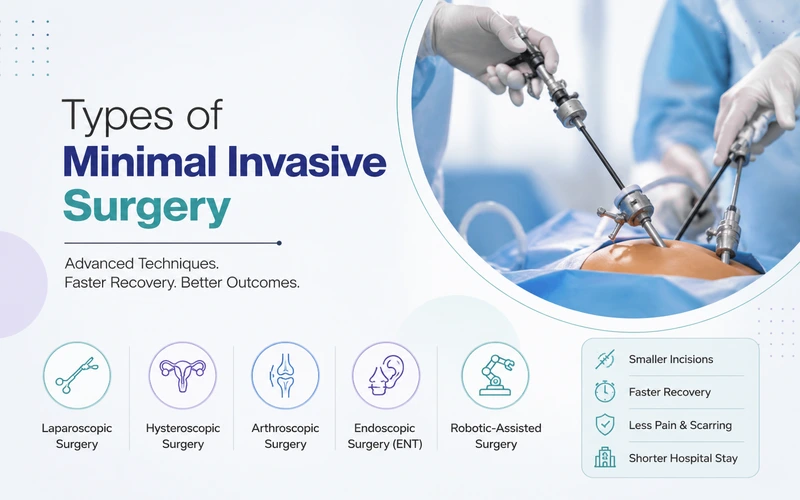
Most laparoscopic procedures are performed through 1–4 small incisions, typically measuring between 0.5 and 1.5 cm, allowing surgeons to access the affected area with specialized instruments and a high-definition camera.
Minimally invasive surgery has transformed the way many surgical conditions are treated by reducing the need for large incisions while maintaining effective clinical outcomes. Today, several minimally invasive surgeries are used across specialties such as general surgery, gynaecology, orthopaedics, urology, cardiothoracic surgery, and gastroenterology. Depending on the condition, these procedures may offer benefits such as reduced postoperative pain, shorter hospital stays, and faster recovery compared with traditional open surgery.
If you are wondering what is minimally invasive surgery, how safe it is, or which procedures are available, understanding the different types of minimally invasive surgery is the first step. This guide explains the major surgical techniques, provides examples of minimally invasive procedures, discusses their safety, and outlines the factors that influence treatment decisions and procedure costs at a minimally invasive surgery hospital in Delhi.
What Is Minimally Invasive Surgery?
Minimally invasive surgery refers to surgical techniques that treat medical conditions through small incisions instead of the larger cuts used in traditional open surgery. A tiny camera, known as a laparoscope or endoscope depending on the procedure, provides a magnified view of the surgical area, while specially designed instruments are used to perform the operation with precision.
Unlike conventional surgery, which often requires a large incision to access the affected organ, minimally invasive surgeries aim to minimize disruption to healthy tissues. As a result, many patients experience less postoperative discomfort, shorter hospital stays, and quicker recovery when the procedure is appropriate for their condition.
How Does Minimally Invasive Surgery Work?
The exact technique depends on the procedure being performed, but the general steps include:
- Small incisions are made near the surgical site.
- A high-definition camera is inserted to provide a clear view of the internal organs.
- Specialized surgical instruments are introduced through additional small openings.
- The surgeon performs the procedure while viewing magnified images on a monitor.
- Once the surgery is complete, the instruments are removed and the small incisions are closed.
Some advanced procedures also use robotic-assisted systems, where the surgeon controls robotic instruments to perform highly precise movements during the operation.
Example of Minimally Invasive Surgery
Several procedures across different medical specialties use minimally invasive techniques. Common examples include:
- Laparoscopic gallbladder removal (Cholecystectomy)
- Laparoscopic appendectomy
- Laparoscopic hernia repair
- Arthroscopic knee or shoulder surgery
- Hysteroscopic removal of uterine polyps
- Thoracoscopic (VATS) lung surgery
- Robot-assisted prostate surgery
- Endoscopic removal of gastrointestinal polyps
Each procedure is selected based on the patient’s diagnosis, overall health, and the surgeon’s clinical assessment.
Although minimally invasive surgery offers several advantages, it is not suitable for every condition. The most appropriate surgical approach depends on factors such as disease severity, previous surgeries, anatomical considerations, and the expertise available at a minimally invasive surgery hospital in Delhi.
Types of Minimally Invasive Surgery
Modern minimally invasive surgery includes several techniques that allow surgeons to treat conditions through small incisions or natural body openings, depending on the organ being treated.
There is no single type of minimally invasive surgery. Instead, surgeons choose from different surgical techniques based on the patient’s condition, the affected organ, and the complexity of the procedure. Below are the most commonly performed minimally invasive surgeries across various medical specialties.
1. Laparoscopic Surgery
Laparoscopic surgery, also known as keyhole surgery, is one of the most widely performed minimally invasive techniques. It uses a laparoscope (a thin camera) and specialized surgical instruments inserted through small incisions.
Common procedures include:
- Gallbladder removal (Laparoscopic Cholecystectomy)
- Appendix removal (Laparoscopic Appendectomy)
- Hernia repair
- Bariatric (weight-loss) surgery
- Colorectal surgery
This technique is commonly used in general surgery because it often reduces postoperative pain and shortens recovery time.
2. Robotic-Assisted Surgery
Robotic-assisted surgery is an advanced form of minimally invasive surgery in which the surgeon controls robotic arms from a surgical console. The robotic system translates the surgeon’s hand movements into highly precise instrument movements.
Common procedures include:
- Prostate surgery
- Kidney surgery
- Colorectal procedures
- Gynaecological surgeries
- Selected gastrointestinal surgeries
Robotic systems provide enhanced visualization and precision, particularly during complex procedures.
3. Endoscopic Surgery
Endoscopic procedures use a flexible tube fitted with a camera to examine or treat organs through natural body openings, eliminating the need for large incisions in many cases.
Examples include:
- Upper gastrointestinal endoscopy
- Colonoscopy with polyp removal
- Endoscopic Retrograde Cholangiopancreatography (ERCP)
- Bronchoscopy
These procedures are commonly used for both diagnosis and treatment.
4. Arthroscopic Surgery
Arthroscopy is a minimally invasive technique used to diagnose and treat joint conditions through very small skin incisions.
Common procedures include:
- ACL reconstruction
- Meniscus repair
- Shoulder rotator cuff surgery
- Cartilage repair
Orthopaedic surgeons frequently use arthroscopy for sports injuries and degenerative joint disorders.
5. Thoracoscopic (VATS) Surgery
Video-Assisted Thoracoscopic Surgery (VATS) allows surgeons to perform operations inside the chest without opening the rib cage through a large incision.
Common procedures include:
- Lung biopsy
- Removal of lung nodules
- Treatment of pneumothorax
- Selected lung cancer surgeries
6. Hysteroscopic Surgery
Hysteroscopy is performed through the cervix using a thin telescope, allowing surgeons to treat conditions inside the uterus without making external incisions.
Common procedures include:
- Uterine polyp removal
- Fibroid removal
- Adhesion treatment
- Endometrial assessment
7. Endovascular Procedures
Endovascular surgery treats diseases affecting blood vessels using catheters inserted through a small puncture, usually in the groin or wrist.
Examples include:
- Angioplasty
- Stent placement
- Endovascular aneurysm repair (EVAR)
- Peripheral artery interventions
These procedures often avoid the need for conventional open vascular surgery.
Choosing the appropriate type of minimally invasive surgery depends on your diagnosis, overall health, and the surgeon’s expertise. An experienced surgical team at a minimally invasive surgery hospital in Delhi can determine which technique offers the safest and most effective treatment for your condition.
Minimally invasive surgery has transformed the treatment of many medical conditions by offering effective surgical solutions through smaller incisions and advanced technology. From laparoscopic and robotic-assisted procedures to endoscopic and arthroscopic techniques, the appropriate approach depends on the patient’s diagnosis, overall health, and surgical requirements.
While these procedures can provide benefits such as reduced postoperative discomfort and faster recovery for suitable candidates, every surgical decision should be based on a thorough medical evaluation by an experienced surgeon.
If you are considering minimally invasive surgery for a surgical condition, the experienced specialists at Primus Hospital offer comprehensive evaluation and personalized treatment using advanced laparoscopic, robotic, and other minimally invasive techniques.
Schedule a consultation with the surgical experts at Primus Hospital today to determine whether minimally invasive surgery is the right treatment option for your condition.