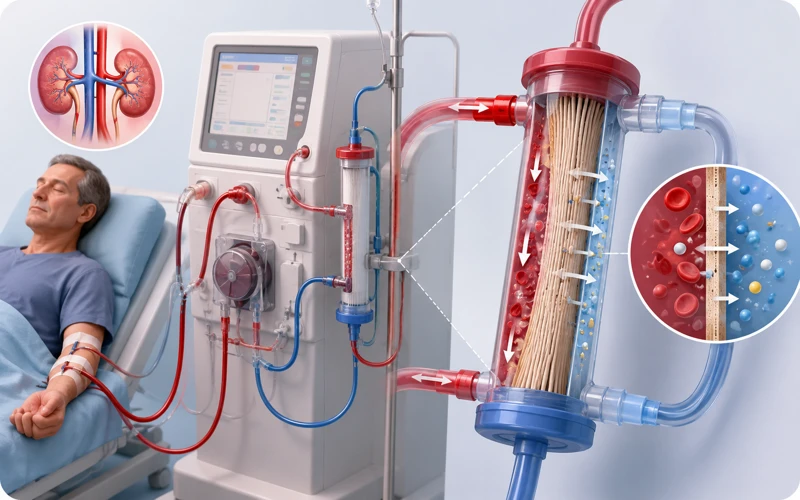
Chronic kidney disease affects about 10% of the global adult population, with a significant portion progressing to kidney failure requiring dialysis. Dialysis replaces lost kidney function by filtering waste, excess fluids, and toxins from the blood when kidneys stop working effectively. In Delhi, both good government and top private hospitals provide dialysis through structured outpatient and emergency care systems.
A standard hemodialysis session usually lasts 3–5 hours and is repeated about three times per week depending on patient condition. Demand for dialysis in Delhi continues to rise due to diabetes, hypertension, and late-stage kidney disease cases requiring regular long-term nephrology treatment in Delhi.
This guide explains how dialysis is done, dialysis meaning in Hindi, types of dialysis available in Delhi, charges in government and private centres, and access to 24×7 emergency dialysis units in Delhi hospitals.
How Dialysis Is Done in Delhi Kidney Hospitals
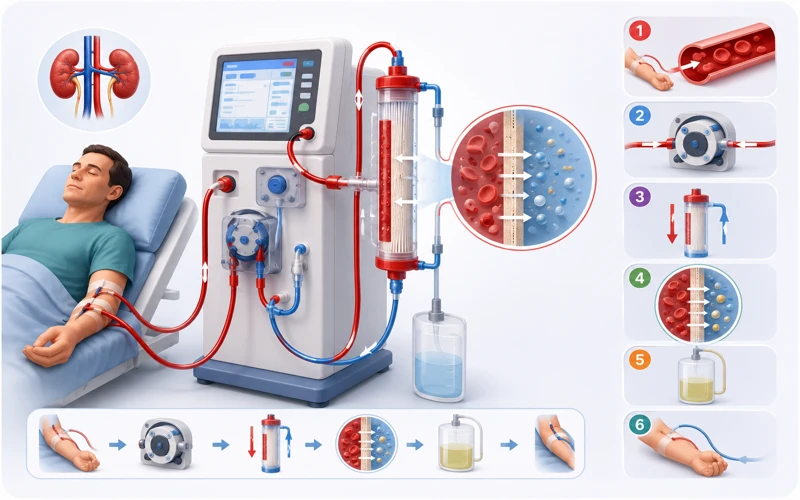
A dialysis session involves 5 key clinical steps starting from patient assessment to blood filtration completion in a controlled hospital environment. In a nephrology hospital in Delhi, this process follows standardized nephrology process in both government and private 24×7 dialysis centres.
- Step 1: Patient registration and pre-assessment begins when blood pressure, weight, and kidney function status are checked before the procedure starts. Nurses confirm vascular access readiness and review recent complications like fluid overload or electrolyte imbalance.
- Step 2: Dialysis machine setup involves connecting the dialyzer, blood tubing, and sterile filters under strict infection control conditions. In Delhi’s hospital dialysis units, machines are calibrated before each session to ensure correct fluid removal rates.
- 3–5 hours per hemodialysis session is the standard duration used in most Delhi dialysis centres depending on patient condition and toxin buildup levels. During this time, blood is circulated through a dialyzer where waste products and excess fluid are removed before returning clean blood to the body.
- 2 access types are commonly used for dialysis in Delhi hospitals: arteriovenous (AV) fistula and central venous catheter. AV fistula is preferred for long-term patients due to lower infection risk, while catheters are used in emergency or 24×7 dialysis cases where immediate access is required.
- Step 5: Post-dialysis monitoring includes checking blood pressure stability, bleeding at access sites, and patient recovery status before discharge. Many Delhi dialysis centres observe patients for 30–60 minutes after the session to prevent complications like hypotension or dizziness.
Types of Dialysis Available
In Delhi hospitals and dialysis centres, treatment is provided mainly in three clinically approved formats depending on kidney failure severity, patient condition, and emergency requirement.
1. Hemodialysis (HD)
- Most commonly used dialysis type in Delhi hospitals
- Blood is filtered using a dialysis machine and dialyzer
- Requires vascular access through AV fistula or catheter
- Each session typically lasts 3–5 hours
- Usually performed 2–3 times per week based on kidney function
2. Peritoneal Dialysis (PD)
- Uses the patient’s abdominal lining (peritoneum) as a natural filter
- A sterile dialysis fluid is inserted into the abdominal cavity through a catheter
- Waste products are absorbed into the fluid and then drained out
- Can be performed at home after training in Delhi nephrology centres
3. ICU or Emergency Dialysis
- Used for critically ill patients in intensive care units
- Continuous monitoring of blood pressure and electrolytes
- Preferred in cases of multi-organ failure or severe fluid overload
- Available in 24×7 emergency dialysis centres in Delhi hospitals
Dialysis cost in Delhi | Private Centres and Nephrology Hospitals (Detailed Cost Breakdown)
Dialysis cost in Delhi is not fixed. It varies based on hospital category, dialysis type, emergency requirement, and patient condition. In most cases, a patient requires around 12–13 sessions per month, making dialysis a long-term financial commitment.
1. Cost Structure Overview in Delhi
| Hospital Type | Cost per Session | Monthly Cost (12–13 sessions) | Waiting Time | Services Included |
| Government Hospitals | ₹0 – ₹500 (subsidized/free under schemes) | ₹0 – ₹6,000 | High | Basic dialysis setup |
| Semi-Government / Trust Hospitals | ₹800 – ₹1,500 | ₹10,000 – ₹18,000 | Medium | Standard monitoring |
| Private Hospitals | ₹1,500 – ₹4,000 | ₹18,000 – ₹48,000 | Low | Advanced machines + nephrologist |
| Premium 24×7 Emergency Centres | ₹3,000 – ₹6,000 | ₹36,000 – ₹72,000 | Immediate | ICU support + emergency dialysis |
2. Government Dialysis Cost in Delhi
Government hospitals in Delhi offer dialysis under national and state health programs.
- Many sessions are free under Pradhan Mantri National Dialysis Programme
- Some hospitals charge minimal consumable fees (₹0–₹500)
- High patient load leads to waiting time of several days in non-emergency cases
- Facilities include basic hemodialysis machines and trained staff
3. Private Hospital Dialysis Pricing
Private hospitals in Delhi provide faster and more flexible dialysis scheduling.
- Standard hemodialysis: ₹1,500 – ₹4,000 per session
- ICU dialysis or critical care: ₹4,000 – ₹6,000 per session
- Home dialysis support programs may cost more due to logistics
What influences private cost:
- Machine quality and water purification systems
- Nephrologist consultation inclusion
- Emergency admission availability
- Infection control infrastructure
Hemodialysis Process at a 24×7 Dialysis Centre
Hemodialysis in Delhi 24×7 centres follows a fixed clinical protocol designed for stable and emergency kidney failure patients. The process uses a machine to filter blood outside the body and return it in a purified form.
1. Patient Preparation and Entry Check
- Patient weight is recorded to calculate fluid removal volume
- Blood pressure and oxygen levels are measured before starting
- Medical staff checks vascular access (AV fistula or catheter)
- In emergency 24×7 dialysis cases in Delhi, catheter access is often used for immediate treatment
2. Vascular Access Connection
- 2 needles are inserted into AV fistula or catheter lines
- One line removes blood from the body
- Second line returns filtered blood after purification
- Infection control protocols are strictly followed in all Delhi dialysis units
3. Blood Filtration Through Dialyzer
- Blood passes through a semipermeable membrane called a dialyzer
- Waste products like urea and creatinine are removed
- Excess fluid is extracted based on pre-calculated limits
- This process continues for 3–5 hours per session
4. Continuous Monitoring During Session
- Blood pressure is monitored every 30–60 minutes
- Machine flow rate is adjusted according to patient response
- Symptoms like cramps, dizziness, or hypotension are managed immediately
- Nephrologist supervision for high-risk patients
5. Post-Dialysis Recovery and Discharge
- Needles are removed and access sites are bandaged
- Patient is observed for 30–60 minutes after treatment
- Vital signs are rechecked before discharge
- Fluid balance and weight reduction are documented for next session planning
Peritoneal Dialysis Process in Delhi
Peritoneal dialysis (PD) in Delhi is a home-based kidney replacement therapy that uses the lining of the abdomen (peritoneum) to filter waste and excess fluid from the blood.
1. Catheter Placement
- A soft silicone catheter is surgically inserted into the abdominal cavity
- Procedure is done in a sterile operation room in Delhi hospitals
- Healing period of 1–2 weeks is required before starting dialysis
2. Dialysate Fluid Exchange
- Sterile dialysis fluid is filled into the abdomen through the catheter
- Waste products and excess fluids move from blood into this fluid
- The fluid remains inside the abdomen for a fixed dwell time
3. Drain and Replace Cycle
- Used fluid is drained out after several hours
- Fresh dialysate is then reintroduced
- This cycle is repeated multiple times per day or overnight using a machine (cycler)
Signs That Require Immediate Dialysis in Delhi
Early recognition of kidney failure symptoms is critical for initiating timely dialysis. Patients in Delhi should seek immediate care if any of the following signs appear.
1. Fluid Overload
- Rapid swelling in legs, hands, or face
- Shortness of breath due to fluid accumulation in lungs
- Sudden weight gain of 2–3 kg in 24 hours
2. Electrolyte Imbalance
- High potassium levels causing muscle weakness or irregular heartbeat
- Persistent nausea, vomiting, or abdominal discomfort
- Confusion or dizziness due to toxin buildup
3. Reduced Urine Output
- Urine volume drops significantly or stops completely
- Inability to pass urine accompanied by discomfort or pain
- May indicate acute kidney injury requiring emergency dialysis
4. Severe Fatigue and Weakness
- Extreme tiredness that limits daily activity
- Rapid deterioration in energy levels over a few hours or days
- Often associated with toxin accumulation and fluid imbalance
Conclusion
Dialysis is a lifesaving treatment for patients with kidney failure, available through government hospitals, private hospitals, and specialized 24×7 dialysis centres. Timely recognition of warning signs and access to emergency dialysis can significantly improve outcomes, particularly for elderly patients or those with acute kidney injury.
Primus Hospital’s dialysis unit ensures patients receive safe, timely, and high-quality care in Delhi, making it a reliable option for both routine and emergency kidney failure treatment.